Two market reports on Rockport, both current as of this year, cannot agree on what kind of market this is. One puts the town at roughly two months of supply earlier this year, the classic definition of a seller's market where well-priced homes move fast. Another, tracking the same town as of June 2026, shows 8.3 months of supply, homes sitting an average of 83 days, and language describing Rockport as a buyer's market with room to negotiate.
That is not a rounding error. It is what happens when a single number tries to describe a town that just spent four years, and two separate 2026 votes, deciding to become two different housing markets at once.
The Legal Fight That Just Ended
Rockport is one of the coastal towns required to comply with the state's MBTA Communities Act, the 2021 law that forces cities and towns served by transit, including commuter rail, to zone at least one district for multi-family housing built as of right. For Rockport, that meant land near the Railroad Avenue commuter rail station, the terminus of the MBTA's Rockport Line into Boston's North Station. By car, the same trip runs about 43 miles and roughly 54 minutes.
The town's first attempt to comply came at a Special Town Meeting in May 2022, when residents approved, by simple majority, both townwide accessory dwelling unit provisions and a 12-acre Transit-Oriented Village Overlay District near the Railroad Avenue station. It immediately drew a legal challenge. Resident John Kolackovsky and nine others sued in Essex Superior Court, arguing the changes required a two-thirds vote, not a simple majority, and that the district amounted to illegal spot zoning because it was drawn to include a strip mall while sparing other neighborhoods within the same half mile of the station.
That suit was still pending in 2024 when the town went back to Town Meeting with a larger fix. On April 29, 2024, voters approved an expanded zoning district, encompassing the original 2022 overlay, to satisfy further state compliance requirements. The day before that vote, Kolackovsky's group filed a new lawsuit, this time in federal court, joined by residents and advocacy groups from Hamilton, Wayland, and Wenham raising similar objections in their own towns. Their complaint put the objection in plain terms, describing the loss of
"the security of tighter zoning, primarily single-family zoning, and accompanying greenspace"
that had shaped their decisions to buy and maintain their homes there.
In January 2026, the U.S. Court of Appeals settled it. The court upheld the dismissal of the statutory and constitutional challenges, clearing the expanded district to stand. With the litigation resolved, Rockport's Special Town Meeting on May 16, 2026 finalized the district's current shape: 12.3 acres near the station, estimated by the Metropolitan Area Planning Council to accommodate up to 160 new residential units over time, accessory dwelling units allowed by right in every zoning district in town without the old requirement that a lot be large enough for two dwellings, and a rule that 60 percent of land in any new residential development stay open.
That is one half of what changed in Rockport this year. The other half was a separate, unrelated vote, and it points in almost the opposite direction.
A Second Vote: Becoming a Seasonal Community
On February 28, 2026, the state's Executive Office of Housing and Livable Communities designated Rockport a Seasonal Community under a 2024 statute. The designation is triggered by a specific threshold: a short-term rental rate above 3.25 percent of the town's housing inventory, and more than 12.5 percent of the housing stock used seasonally, occasionally, or otherwise not occupied as a primary residence.
Unlike the transit district, this designation had to be accepted by Rockport's own voters. After an information meeting on March 24, 2026, residents took up the question at the April 11, 2026 Annual Town Meeting and approved it. Accepting the designation commits Rockport, within 24 months, to two new bylaws: one permitting 400 square foot tiny houses as year-round housing, and one permitting construction on lots as small as 10,000 square feet, both aimed squarely at adding housing that a full-time resident, not a seasonal owner, can actually use.
The same vote also settled a smaller but telling dispute over accessory dwelling units. The state's Attorney General had previously invalidated Rockport's six-month minimum lease requirement for ADUs, ruling it an unreasonable restriction under a newer state law meant to standardize ADU rules statewide. Without the Seasonal Community designation, that minimum would have defaulted to 31 days, effectively opening ADUs to short-term rental use townwide. With it, the six-month minimum returns.
Read side by side, the two votes are not contradictory so much as they are aimed at two different problems in two different places. Near Railroad Avenue, the state is forcing density regardless of who lives there. Everywhere else in Rockport, the town just voted to make its smallest new housing units, tiny houses, undersized lots, and ADUs, harder to convert into vacation income and easier to keep in the hands of year-round residents.
Where the Line Actually Runs
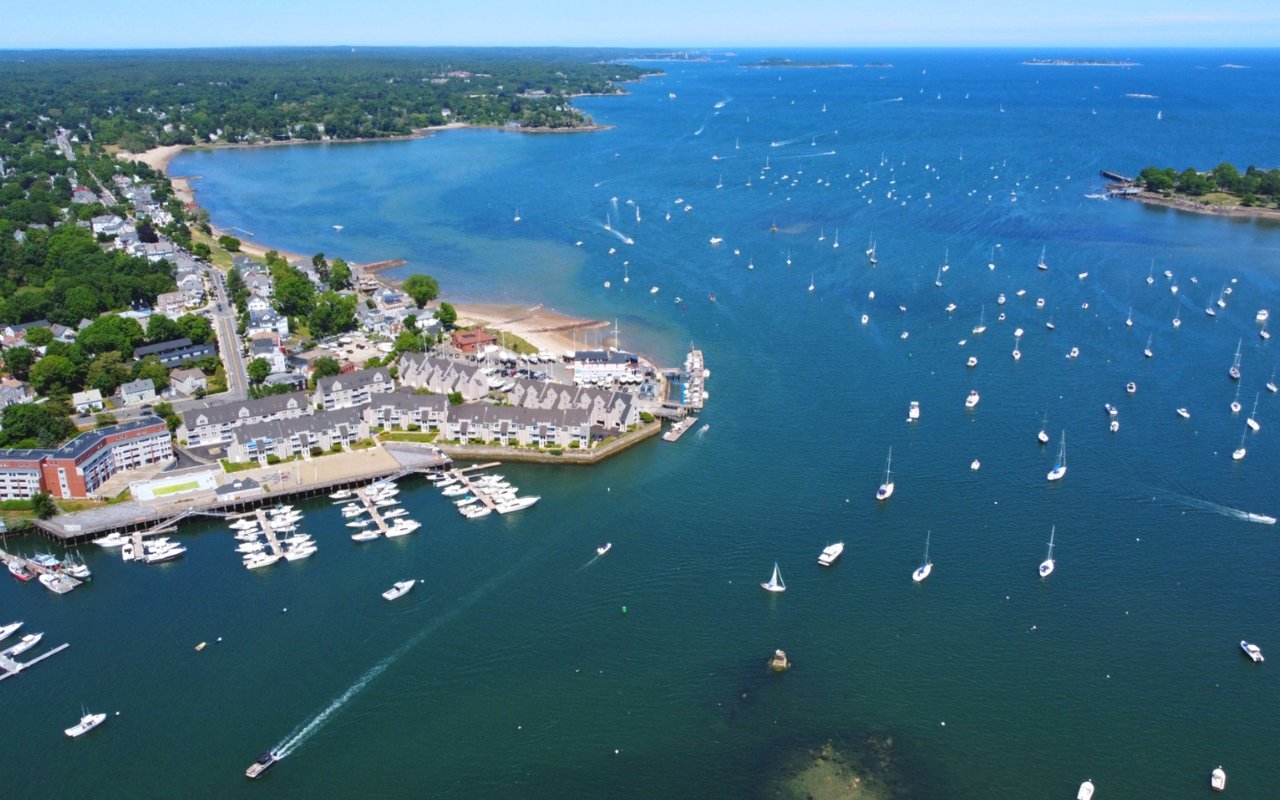
The geography makes the split concrete. Walk Score rates the downtown core around Dock Square and Main Street in the 70s, solidly walkable and close to the same rail line driving the new overlay district. Move a mile or two out to Long Beach or Thatcher Road, the granite coastline that gives Rockport its name and its Bearskin Neck galleries their views, and the same measure drops into single digits. Those two areas were always different markets in character. As of this year, they are different markets by zoning code.
That difference has been building for a long time. Rockport's granite cutter founders settled the area in the 1680s, and the town spent the next two centuries built around quarrying and fishing, not residential subdivision. Annual listing volume tells the same story in modern terms: it has fallen by more than half since 2014, from roughly 141 listings a year to about 60 today, while buyer demand held steady. A town built on an extraction economy rather than a housing pipeline does not correct that kind of imbalance on its own. It took a federal court ruling and two Town Meeting votes in the same year to start.
Reconciling the Two Reports
This is where the contradictory market snapshots start to make sense. The report showing roughly two months of supply and seller's market conditions reflects Rockport as it has functioned for a decade: a small, largely single-family town with a shrinking pool of listings and steady demand. The report showing 8.3 months of supply and buyer's market conditions, current as of June 2026, was measuring the same town just as its zoning was finally settling into two distinct systems.
Neither report is wrong. They are measuring a town in the middle of unbundling. A townwide months-of-supply figure blends a shrinking, tightly held granite coastline with a small but newly opened transit corridor that regulators, not just the market, are actively working to expand. As that corridor absorbs new units over the next several years, expect the townwide average to keep moving in ways that a single number, taken alone, will not explain.
What This Means If You're Actually Shopping Here
If you are looking within easy walking distance of Railroad Avenue, you are looking at the part of Rockport where supply is set to grow. An estimate of up to 160 units does not mean 160 units exist yet, entitlement is not construction, but it does mean this corner of town carries a different medium-term outlook than the rest of Rockport, and ADU rules there are simpler than they used to be.
If you are drawn to the village center, Bearskin Neck, or the granite coastline further out, expect the conditions that have defined Rockport for years to persist: thin inventory, quick sales, and now, if you are counting on an accessory unit for rental income, a six-month minimum lease rather than short-term rental math.
A Few Questions Worth Asking Before You Look
Will the new units near the train station change prices townwide? An estimated 160 units, phased in over time, is small relative to a town of Rockport's size. The more likely effect is local, easing pressure within that specific corridor rather than moving the townwide median.
Can I still run a short-term rental if I buy outside the transit district? The Seasonal Community vote does not ban existing short-term rentals. It does mean that new ADUs built after the town adopts its required bylaws, due within 24 months of the April 2026 vote, will carry a six-month minimum lease rather than the 31-day default that would otherwise have applied.
Is Rockport a buyer's market or a seller's market right now? Depends where in town you're looking. The honest answer, based on the two most recent reports, is that Rockport may be both at once, and the zoning history above is a better guide to which one applies to a specific listing than either report's townwide average.
Rockport's zoning just settled into a shape it will likely hold for years. Knowing which side of that line a listing sits on tells you more about what to expect than any single market report can. If you are weighing a purchase here, or trying to figure out which version of Rockport actually fits what you're looking for, Nest | Syndi Zaiger Group can walk the specifics with you, corridor by corridor.